A personal encounter with the people and places of the American Southwest

Sunday, July 12, 2015

The Barbara Waters Memorial


Taos, New Mexico

Barbara Waters, the fourth and final wife of Frank Waters, the godfather of Southwestern literature, passed away January 11th of this year. She was a fine writer and scholar in her own right, and as head of the Frank Waters Foundation, a vital force in the preservation of her husband’s literary and cultural legacy.

The memorial for Barbara Waters was held at the Millicent Rogers Museum in Taos and at the Frank Waters’ home in Arroyo Seco on June 27th. What follows is a short biography of Barbara Waters abridged from the Frank Waters Foundation website. (To read the entire biography, go to www.frankwaters.org/new_page_3.htm). After the bio, I have added the tribute to Barbara Waters I presented at the memorial – one of many made by her numerous friends.

Barbara Waters: Biography

Barbara Waters was born on September 26, 1929, in Oak Park, Illinois, and grew up in La Grange and Oswego, suburbs of Chicago. While raising her two sons –Terence and William Hayes – she attended Northwestern University and earned a bachelor’s degree in secondary education with an English major.

In 1968 she divorced her first husband and came to Taos, New Mexico, where she met Frank Waters in 1970.That same year she began dividing her time between Taos and Tucson, where she taught English at Canyon del Oro High School until 1985.

Barbara and Frank were married in 1979, the same year that she earned a master’s degree in journalism at the University of Arizona. In 1988 she earned another master’s degree in Counseling and Guidance and began therapy practices in Tucson and Taos. She organized the Frank Waters Foundation in 1993, two years before her husband’s death in 1995.

Barbara discontinued her psychotherapy practices in 1995 to write her memoir Celebrating the Coyote. Her work has appeared in Western American Literature, Chicago Tribune, Arizona Daily Star, and the Salt Journal. She also has essays in Frank Waters: Man and Mystic and in The Spirit That Wants Me and wrote a foreword for The Woman at Otowi Crossing, Frank Waters’ novel about the making of the atomic bomb. In addition to her writings, Barbara Waters was the president of the Frank Waters Foundation, a consultant for the Southern Arizona Friends of C.G. Jung, and a member of the Society of the Muse of the Southwest. 
 
She died January 11, 2015. 
 
Mountains near Arroyo Seco


Barbara Waters Tribute

It is an incredible honor to be asked to speak here at the memorial for Barbara Waters.

When I interviewed Frank Waters for Southwest Profile in June of 1989, there was a festival taking place in Taos, and the traffic crawled through town. I was coming up from Santa Fe, and as the minutes ticked by and the cars inched forward, it became clear that I was going to be quite late. So, a few blocks past the plaza, I pulled over and called Waters from a phone booth. (This was in the Dark Ages before cell phones.) When he answered the phone, he sounded very disappointed, which prompted me to apologize profusely for my lateness. He explained that my lateness wasn’t a problem; instead, he was concerned because Barbara was late returning from Tucson, and the phone rang, he had thought she was calling.

I finally arrived in Arroyo Seco almost an hour late, and we started the interview, which took a couple more hours. At the end, Waters was still clearly very concerned about Barbara, who still hadn’t arrived, and the last thing he said to me, after complaining about the lack of a bypass around Taos, was, “She should be here soon. I think I’ll throw together a little supper for her. I bet she’ll be hungry.”

At the time, I was impressed by Waters’ love and concern for his wife, and I thought she must be a very special person.

Twelve years later, when I met Barbara at the Robinson Jeffers conference at the Mabel Dodge Luhan house, I discovered that Barbara was indeed a great soul. Over the next decade, I visited her repeatedly while researching Frank Waters’ life, including an extended stay at their Arroyo Seco home, and I always found Barbara to be warm, compassionate, intelligent, most helpful, brave in adversity, and sharply honest.

The last time I saw her, my wife Brenda and I visited her in Arroyo Seco, and she was gracious as always, sitting in her armchair, a stack of books and journals on the coffee table in front of her; surrounded by the artwork of Fechin, Lady Brett, and Hopi artisans; the cool aspen-filtered light coming in through the east-facing windows.

I will miss those visits, as we will all deeply miss her presence in this world.

I would like to finish with a passage from the novel The Man Who Killed the Deer. Here, Frank Waters describes the Day of the Dead at Taos Pueblo:

The women kneeled down, lighted more candles, and from under their shawls took out wafer bread, loaves of long-bread, cornmeal baked in cornhusks, pans of panocha, even a cheap store sponge-cake to place on the sunken graves.

It was el Dia de los Muertos, and they had come with offerings for the dead. 

They who lie here were as alive as we are who have not forgotten. We too will lie here and will not be forgotten. Are we all alive, or all dead, in this unceasing file from one mystery to another, through this watery blue veil of November sky? Let no man say. Let him say only: I am the seed of the husk that lies here, my Corn Mother; and I am the seed of those husks which will follow after me; and this meal I now place here is the bond between us all; and may our Earth Mother, our Corn Mother, attest I have not forgotten.

Tuesday, June 9, 2015

A Message from the Frank Waters Foundation


Special Offer: For the month of June, 2015, John Nizalowski will donate to the Frank Waters Foundation all his royalties from the sale of Land of Cinnamon Sun: Essays on Family, Mythology, and the American West. So, during June, you can add this great book to your Southwestern collection and help out the Frank Waters Foundation at the same time. Irie Books, $12.99: Available through Amazon.com.,www.barnesandnoble.com, and through Ingram distributors from your local bookstore (price may vary).

From the back cover:

In Land of Cinnamon Sun, essayist John Nizalowski explores the western experience through the lenses of family, mythology, and the natural world. Here we find red rock canyons, ancient Pueblo Indian cities, and sublime natural bridges connected with the daily realities of contemporary life, a cosmology inspired by Mesoamerican legends, and the frontiers of modern physics. In the tradition of Frank Waters and Terry Tempest Williams, John Nizalowski has written a book that is more than a collection of essays; it is, as described by author Gerald Hausman, “a novel in verse disguised as prose.”

“John Nizalowski deploys through his writings a rhetoric of universals – the timeless, the boundless – in order to evoke in us a feeling of cosmos, not chaos.” – Alexander Blackburn, author of A Sunrise Brighter Still: the Visionary Novels of Frank Waters

“Nizalowski’s prose is pointed, gritty, unsparing in its detail and savagely honest….” – Rosemerry Wahtola Trommer, Telluride Magazine

Thursday, February 26, 2015

Journey to Tuzigoot


Clarkdale, Arizona


One of my favorite ancient sites in the American Southwest is Tuzigoot, a pueblo ruin located in Arizona’s Verde Valley. Resting atop a 120 foot limestone ridge, which provided the white stones used to construct the pueblo’s many rooms and multistory central tower, Tuzigoot stands against the sky, an outpost of time, a human landscape a thousand years old. 

Tuzigoot was originally settled by Hohokam farmers who migrated north from the present day Phoenix area and began farming corn and other crops in the Verde Valley’s rich soil. The Verde Valley also provided salt and other valuable minerals, making it a busy trading center. Around 1000 CE, the Hohokam built a few scattered stone structures on the ridge which would be the future site of Tuzigoot. This ridge was a natural fortress, and gave the Hohokam a wide view of the valley with its winding river, abundant cottonwood trees, and volcanic hills.


In the 12th century, bands of Sinagua from the north began to enter the valley and merged with the Hohokam inhabitants. The Sinagua, who originated on the southwestern frontier of the Anasazi cultural zone, added to the Hohokam houses, creating a many leveled pueblo bearing design influences from the great urban center of Chaco Canyon. Tuzigoot reached its climax in the 13th century, when large numbers of Sinagua left the Flagstaff area fleeing drought and the final, violent eruptions of the Sunset Crater volcano. At this time, the pueblo housed upwards to 500 people.

Perched on its hilltop, Tuzigoot and its high walls protected its dwellers from the 13th century conflicts brought on by drought and population stresses on the valley’s resources. After this time of troubles passed, the pueblo continued to be occupied for another century. But by the 1400’s Tuzigoot was abandoned for reasons that remain one of the mysteries of southwestern archeology. The people of Tuzigoot probably migrated to the northern Arizona highlands, where they joined the Hopi.

A team from the University of Arizona excavated Tuzigoot in the early 1930’s, and today one can wander through its numerous chambers and climb a wooden ladder to the top of its cubical tower, there to see out across the lands that were once verdant with the fields of the Hohokam and the Sinagua.


I wrote a poem after visiting Tuzigoot in 2012. The discovery that the Sinagua buried their dead in the deepest layers of the pueblo inspired the poem’s central imagery.


Tuzigoot

Underneath the white stone walls
that climb the hill to the summit,
the old pale bones of children rest.

My youngest daughter feels their
voices at her feet, her sister instead
remembers playing in the outer room,

the one that faces west and the long
Verde Valley. A whip snake flows
like water across the pueblo rubble

heading for the shade of a salt bush.
We three watch it vanish into the
shadow, a lost member of the family.

Friday, October 31, 2014

Curbside Nature


Grand Junction, Colorado 

I have long been fascinated by places where the natural and urban worlds intersect. An abandoned factory choked by foxtail barley, sumac, and snakeweed is an intriguing maze of metal and cellulose. A decommissioned iron girder bridge presents a paradise for barn swallows and their oval mud-daubed nests all in a row. And while it is always a delight to find a beaver dam, the discovery is just a touch surreal when suburban tract houses are within view of the structure’s tangled branches.

Here in Grand Junction, Colorado, there are many interzones where nature penetrates the works of humanity. This is partly due to the city’s modest size – the whole Grand Valley, home to a string of small cities, is a bit over 100,000 in population. In addition, a semi-arid wilderness surrounds the valley, so that the city edges out into vast stretches of unsettled canyons and mesas.

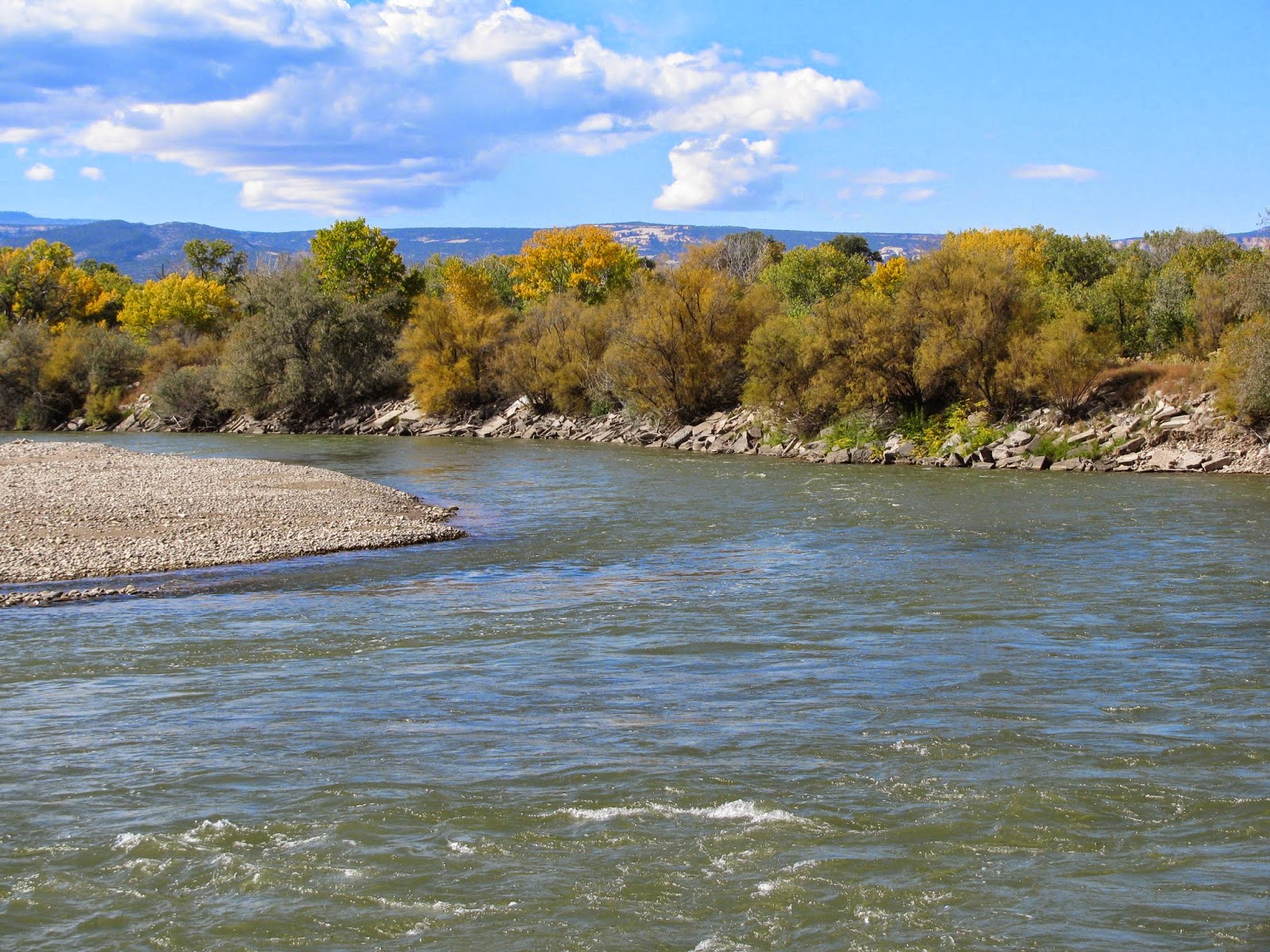
But perhaps the most important source for Grand Junction’s areas of untamed flora and fauna is the Colorado River. Grand Junction is the largest metropolis on the Colorado’s 1500 mile passage from La Poudre Pass in the Rocky Mountains to Mexico’s Sea of Cortez. The river divides the city, and the municipal and state governments have kept Junction’s riverbanks largely undeveloped, preserving them as wetlands. Thus, in Grand Junction, surrounded by homes and businesses, streets and highways, the Colorado is a corridor for the natural world.
Along much of this corridor, city and state agencies have constructed a series of trails, and after a long day in the classroom, I often head for the Colorado River Trail system. There, sometimes mere yards from city streets, I can walk through groves of cottonwoods, Russian olive, and tamarisk, skirting lakes, streams, canals, and sometimes the river itself.

A partial list of the natural denizens I have spotted near these trails includes cottontail rabbits, jack rabbits, gray squirrels, mule deer, beaver, great horned owls, red-tailed hawks, Swainson’s hawks, northern flickers, orioles, ravens, magpies, great blue herons, Canadian geese, mallards, wood ducks, spadefoot toads, leopard frogs, whiptail lizards, garter snakes, praying mantis, and monarch butterflies. Once I walked through hundreds of golden dragonflies mysteriously swarming around a fallen cottonwood trunk; another time I came upon a nest filled with newly hatched mallard ducklings. There are often surprises like these, natural encounters I would expect in the deep wilds, not within the sound of car horns.

Now, I do not want to give the impression that these trails are untouched wilderness. The city certainly intrudes. On the trail that skirts Corn Lake, where massive cottonwoods face high shale bluffs along the Colorado, the thrumming sound of the Halliburton plant is frequently an unavoidable irritation. Along much of the trail, one can hear the snap and buzz of the high tension power lines overhead. Occasionally, the smell of diesel exhaust wafts through the air. Drained beer cans, used disposable diapers, and charred fast-food wrappers grace the trail’s border. One day I came upon an unlabeled five gallon glass jug sitting alone in the midst of an alkaline flat, a strange mystery my terrier-mix dog Myla approached with great trepidation. And tucked away in the tamarisk labyrinths stand the homeless camps, their plywood lean-tos and canvas shelters a reminder of our nation’s economic and social inequities.

Still, the Colorado River Trail system provides a quick escape from the city’s tame landscape, reminding us that despite all the recent urban and industrial development in the Southwest, nature is still in charge. As Frank Waters expresses it in his exemplary portrait of the region, The Colorado (Swallow Press, 1946): “This is a country where the land predominates, not man. It contains the highest peaks, the largest mountain ranges, the widest plateaus, the deepest cañons, and the lowest deserts in America. Geology here forever dominates life and gives it its ultimate meaning” (4).


Postscript

There is a wonderfully written review by Suellen Alfred of Land of Cinnamon Sun in the on-line creative non-fiction magazine Under the Sun. You can access it at http://underthesunonline.com/review-of-nizalowskis-land-of-cinnamon-sun/

In addition, there is a nicely done photo feature of Land of Cinnamon Sun and other offerings from Irie Books in a blog run by Longhouse Publishers & Bookstore. The other books pictured with my collection are The Street by Aram Saroyan and Places of Mystery, Power, and Energy by Bill Worrell, again all on Irie Books. You can access this feature at http://longhousepoetryandpublishers.blogspot.com/2014/09/irie-books.html

Also of interest: Grand Canyon Backpacking Stories edited by Rick Kempa is the first-ever anthology devoted to the Grand Canyon backpacking experience. In it, twenty-seven writers offer tales that encompass the full range of the canyon backcountry experience: adventure, discovery, danger, deep solitude. Novice hikers express their wide-eyed wonder, while veteran canyoneers reflect on how the place has shaped their character. Rangers, trail workers, scientists, and guides provide unique perspectives. Writing from the corridor trails, the backcountry trails, and the vast canyon wilderness, the authors offer intimate views of what it is like to be afoot beneath the rim. For more information, visit http://www.vishnutemplepress.com/.  To read the table of contents and the introduction, visit rickkempa.com.


Tuesday, October 7, 2014

Gods of Fire, Gods of Stone


Bird Springs, Arizona  

I recently journeyed to Flagstaff for a few days to see my youngest daughter, Isadora, a chemistry major at Northern Arizona University. It was a rather rushed visit, but we did find the time to buy several vintage vinyl records at Bookman’s, drink a mocha at Macy’s, and grab an egg sandwich for breakfast at the Galaxy Diner.

Normally to get back home to Grand Junction, I drive straight north on U.S. 89 to U.S. 160, head northeast through Tuba City and Kayenta to Mexican Water. In Mexican Water, I catch U.S. 191 north all the way through Moab, Utah to Interstate 70. I take this east to Junction, which is just over the Colorado line. It’s a wonderful drive through some of the Southwest’s most interesting landscapes – the pyramidal peaks of the San Francisco Mountains, the Moenkopi Plateau’s Painted Desert, Kletha Valley with its twisted canyons, the mysterious frozen wave of Comb Ridge, the high bluffs surrounding the San Juan River, the Utah canyon lands’ easternmost reaches, and the towering La Sal Mountains. Visually, the La Sal Mountains closely echo the San Francisco Peaks, and both snow-capped ranges create perfect bookends for the drive. They also possess a strong mythological parallel: the La Sals are the home of the Ute Sun God, and the San Francisco Peaks are the dwelling place of the Hopi deities known as the Kachinas.

But this time, I wanted to see some different territory, so I went east along Navajo Route 15. This highway starts near Flagstaff in the small mining town of Winona, and passes through a sequence of Navajo villages – Leupp, Bird Springs, Dilkon, Indian Wells, and Lower Greasewood – finally connecting with U.S. 191 near Ganado. From there it’s due north through Chinle, Many Farms, Round Rock, Rock Point, and finally Mexican Water, where I linked back up with my usual route. What I enjoy most about taking Navajo 15 are the expansive spaces, the absence of traffic, and the traditional Navajo towns, with their octagonal hogans, stucco chapter houses, and modern schools, where students with backpacks queue up for big yellow buses to take the long ride home. Between towns, the grasslands hold half-wild horses, wool muffled sheep, and native herding dogs, which N. Scott Momaday describes in his essay “The Indian Dog” as being “marvelously independent and resourceful” and “having an idea of themselves . . . as knights and philosophers.”
 

From Winona to Lower Greasewood, the voyager passes through many volcanic necks, ash cones, and basaltic buttes – all a part of the San Francisco volcanic field, named for the San Francisco Peaks. This zone of volcanism is eight million years old, and contains over 600 volcanoes, all of them extinct, at least for now. A mere 750 years ago, one of these volcanoes, Sunset Crater, erupted. According to Ekkhart Molotki in the book Earth Fire (Northland Press, 1987), Sunset Crater entered Hopi legend as a Ka’nas Kachina’s fiery revenge on the village of Musangnuvi because some jealous people there tricked his wife into committing adultery.

As I drove through this volcanic field along Navajo Route 15, I thought about the Hopi Mesas only fifty miles to the north, and speculated, not for the first time, that the proximity of such an extensive volcanic landscape had helped shape the attributes of the Hopi god Masau’u.


As explained by Hamilton A. Tyler in Pueblo Gods and Myths (University of Oklahoma Press, 1964), Masau’u is the “god of death and fire … who was kept at bay by the magic of fire rituals.” However, he is also associated with fertility, for he tends an underworld fire which can cause “his crops to grow with magic speed” (4). While having a trickster nature, he is also a god of boundaries, property, and travelers. In Hopi spiritual practice, the One Horn Society priests guide the spirits of the dead to the kiva of Masau’u, from whence they enter the underworld. Because of these powers, the Hopi associate Masau’u with the stone piles and slabs that mark the boundaries of a clan’s farmland, a tribe’s territory, and graves.
 
Now, readers of my last dispatch from Mack, Colorado may be noting the remarkable similarities between Masau’u and the Greek god Hermes. Hermes, whose name means “he of the stone heap,” is also associated with the stone markers that delineate property, territory, and graves. Therefore, like Masau’u, he is a deity connected with death and travel. Hermes is also a god of fertility, and, as with the Hopi fire god, can make plants “grow with magic speed.” This Hermes does when he steals the Cattle of the Sun, and butchers several of them by making willows surge out of the ground and tear the animals asunder, an act that also demonstrates Hermes’ identity as a trickster. Like Masau’u, Hermes’ trickery emerges from his identity as “the crosser of boundaries.” And just as Masau’u is a god of fire, it is said that Hermes invents fire; and while the One Horn priests guide the dead to Masau’u, Hermes himself guides the dead to Hades.

There is a profound archetypal pattern here, welling up on opposite sides of the planet in two agricultural city-state cultures that blended a deeply mystical nature with an empirical pragmatism needed to survive in a semi-arid environment amid hostile neighbors.

And while there were signs pointing the way on Navajo Route 15, not stone markers, I believe the spirit of Masau’u, and perhaps of Hermes too, still dwells in the volcanic rocks, mesas, and mounds through which I passed on the two-lane asphalt ribbon leading me home.


Postscript

The author of over thirty books, Roger Zelazny, who passed away in 1995, was one of the 20th century’s greatest authors of science-fiction and fantasy. For nearly a quarter of a century, Zelazny lived in Santa Fe, and the Southwest became the setting for a number of his pieces, most notably Eye of Cat, his novel about a Navajo tracker pursued into Arizona’s Canyon de Chelly by a shape-shifting alien. One of his last novels, Night in the Lonesome October, is a wondrous blend of 1930’s movie monsters, Sherlock Holmes, and H.P. Lovecraft’s Cthulhu Mythos – all told from the point of view of Jack the Ripper’s dog. Zelazny constructed the novel in 31 chapters, one for each day in October. Currently, Jane Lindskold, Zelazny’s companion and a superb fantasy author in her own right, is celebrating the novel with a Twitter book club, and will share tweets devoted to each chapter on each day in October. It’s not too late to join in. Details at https://www.facebook.com/janelindskold #LonesomeOctober.